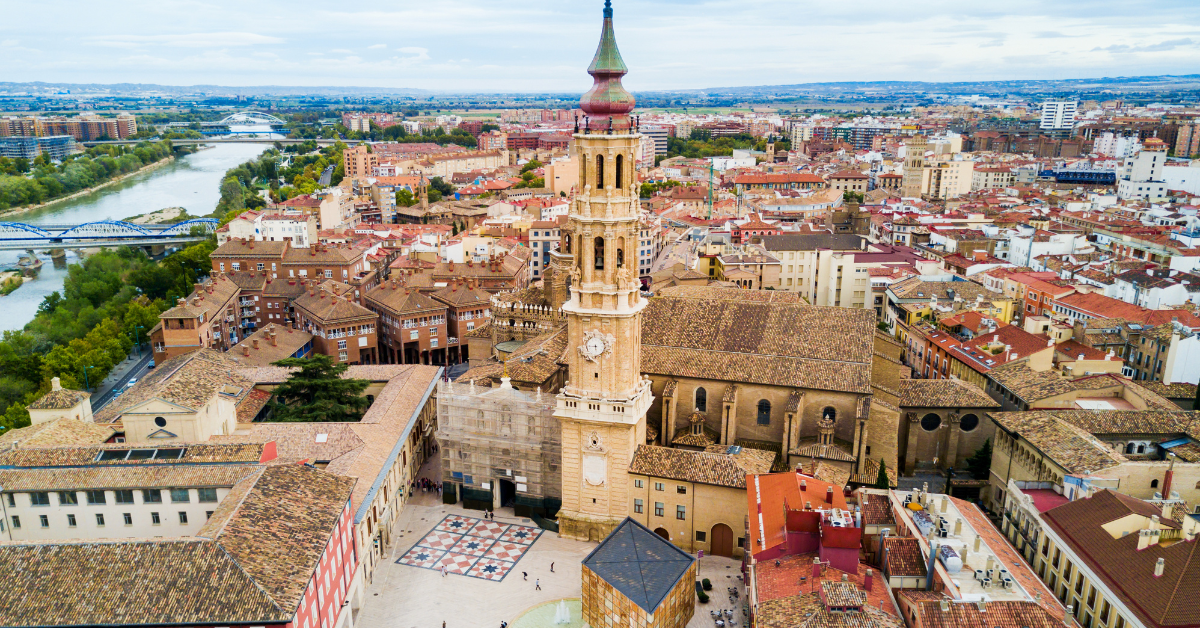


Zaragoza, a historic city located in northern Spain, is typically written in katakana in Japanese. However, the phonetic kanji transcription “沙羅哥薩” is sometimes used. In this article, we explore the background of this kanji representation and delve into Zaragoza’s historical significance, cultural richness, and its presence in sports—all from the perspective of how Japanese people perceive this city.
What Kind of City is Zaragoza?
Zaragoza is the capital of the Spanish region of Aragon, situated along the Ebro River. It originated during Roman times as “Caesaraugusta,” and has developed under the influence of Roman, Islamic, and Christian cultures.
Especially notable is the way its architecture reflects multiple periods and faiths, giving the city a deeply historical atmosphere.
| Item | Details |
|---|---|
| Region | Aragon |
| Geography | Along the Ebro River, between Madrid and Barcelona |
| Origin | Roman-era city named Caesaraugusta |
| Today’s Identity | A fusion of culture, history, and sports |
How is “沙羅哥薩” Interpreted in Japanese Kanji?
“沙羅哥薩” is not an official transcription, but a phonetic rendering that captures the sound of “Zaragoza” in kanji characters.
| Kanji | Phonetic Sound | Implied Meaning (Cultural Perception) |
|---|---|---|
| 沙羅 | “Sara” | Buddhist term, evokes mysticism and spirituality |
| 哥 | “Go” | Means song or brother in Chinese |
| 薩 | “Sa” | Associated with bodhisattvas, suggesting nobility |
Though these characters do not convey literal meaning about the city, their imagery resonates with Japanese cultural and spiritual sensibilities. Thus, “沙羅哥薩” is appreciated as a visually and phonetically aesthetic representation.
Zaragoza’s Historical Architecture and Its Allure
Zaragoza is home to multiple globally significant architectural landmarks, each reflecting different eras and religious traditions.
| Landmark | Style | Characteristics |
|---|---|---|
| Basilica of El Pilar | Baroque | Center of Marian devotion; renowned for ceiling frescoes and towers |
| La Seo Cathedral | Gothic + Baroque | Fusion of religion and fine art; features sculptures and stained glass |
| Aljafería Palace | Mudéjar (Islamic-Gothic) | One of Spain’s few remaining Islamic fortresses |
These are not just sightseeing spots but symbols of the city’s cultural intersectionality. Due to frequent appearances in textbooks and media, Zaragoza is perceived in Japan as a city rich in historical narrative.
Zaragoza as a Sports City
In addition to history and culture, Zaragoza is also prominent in the sports world, especially football. The city hosts the professional club Real Zaragoza, which has achieved notable success.
| Club | Established | Major Achievements |
|---|---|---|
| Real Zaragoza | 1932 | Copa del Rey winners, UEFA Cup Winners’ Cup champions |
The home stadium, La Romareda, regularly fills with passionate fans. On match days, the entire city becomes electrified, offering a unique experience even for visitors.
Aside from football, basketball, tennis, and cycling are also popular, supported by solid sports infrastructure. Zaragoza integrates athleticism seamlessly into daily life.
Zaragoza’s Uniqueness Compared to Other Spanish Cities
Zaragoza stands apart when compared with other famous Spanish cities. The table below illustrates its distinctive traits:
| City | Defining Characteristics |
|---|---|
| Madrid | Capital; political and economic center |
| Barcelona | Hub of art and tourism, home to Gaudí’s legacy |
| Seville | Deep Catholic culture, flamenco, passionate lifestyle |
| Zaragoza | Multilayered history, strong integration of sports and culture |
Zaragoza might appear modest at first, but it offers multifaceted appeal. Its combination of architecture, religion, art, and sports makes it a favorite among “experience-focused” travelers.
Spiritual Resonance with Japanese Sensibilities
The kanji transcription “沙羅哥薩,” though unofficial, aligns well with Japanese cultural imagination. Characters like “沙羅” and “薩” are commonly found in Buddhist terminology, evoking sanctity and clarity.
Such associations demonstrate how phonetic and visual impressions of foreign names can foster emotional or spiritual connections. This offers insights into the interplay of language and cultural interpretation.
Conclusion
Zaragoza is a city of rich layers—history, culture, architecture, and sports. While “沙羅哥薩” is not an official term, its phonetic beauty and symbolic richness give it unique relevance to Japanese speakers.
With deep historical roots and vibrant modern life, Zaragoza stands not just as a tourist destination, but a narrative-rich city with emotional depth. For Japanese travelers, it embodies a place where ancient legacies and contemporary experiences merge.
Next time you visit Zaragoza, try to explore not just the physical sites but the cultural layers beneath. Doing so may reveal a more profound dimension to your journey.