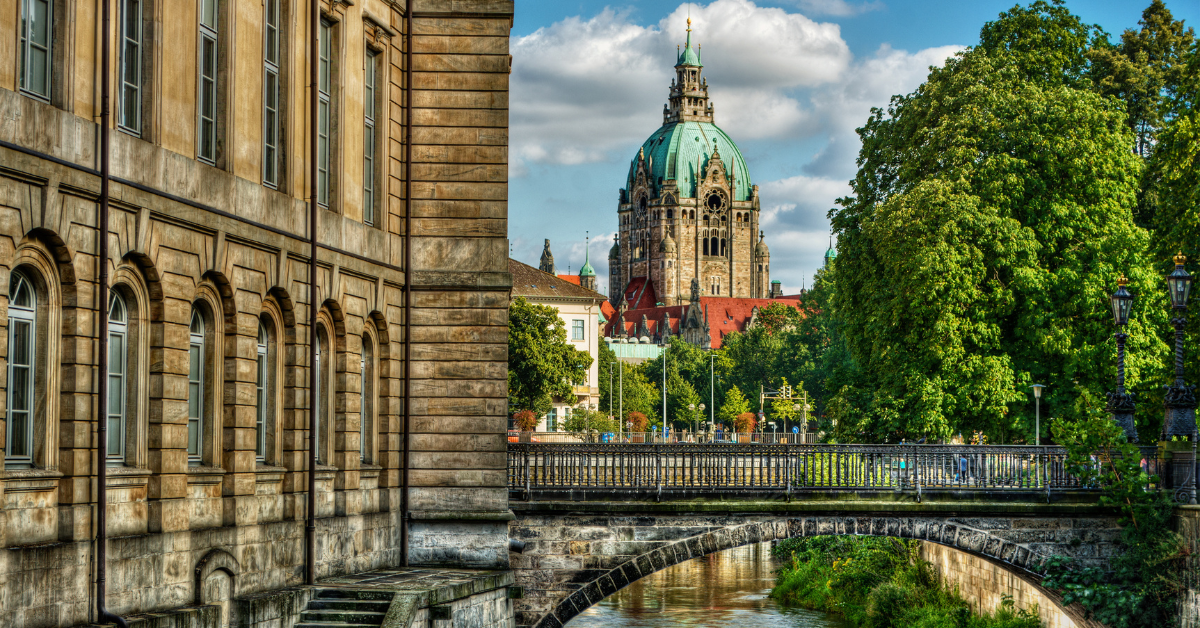

The German city of Hannover has long been recognized as a hub of industry, commerce, and academic research, and today it also stands out for its strong sports culture.
In Japan, the name is usually written in katakana, yet older documents feature fascinating kanji renderings such as 漢那華, 阿諾威, and 黒那法. These expressions capture how early Japanese scholars tried to connect foreign sounds with their own cultural language. This article explores what these names reveal about Japan’s perception of Hannover as a city of intelligence, craftsmanship, and global collaboration.
- Kanji Representations of Hannover and Their Origins
- The Kingdom of Hannover and Its Historical Connection with Japan
- Hannover’s Modern Industrial and Commercial Appeal
- Center for Academic Research and Innovation
- Sports Culture in Hannover
- How Japanese People Perceive Hannover
- Why Katakana Became the Standard
- Conclusion
Kanji Representations of Hannover and Their Origins
The German name “Hannover” is typically transcribed into Japanese as “ハノーファー” or “ハノーヴァー.” However, from the Meiji through early Showa periods, it was common to assign kanji characters to foreign words. These characters were chosen to approximate the sound while conveying meaning or cultural nuance.
| Representation | Reading | Feature | Period of Use |
|---|---|---|---|
| 漢那華 | Kannaka | Phonetically close to Japanese, conveys elegance | Late Meiji – Early Showa |
| 阿諾威 | Anoi | Phonetically accurate transliteration | Used in diplomatic and academic texts |
| 黒那法 | Kuronahō | Rendered in classical Chinese style | Found in certain scholarly works |
These renderings reflect an era when translators sought to make foreign names visually and culturally accessible to Japanese readers. Among them, “漢那華” was favored for its graceful and intellectual tone, often used in journals and literature of the time.
The Kingdom of Hannover and Its Historical Connection with Japan
Hannover was once an independent kingdom, closely linked with the British royal family from the 18th to 19th centuries. Known as the Kingdom of Hannover, it played a significant role in European politics. When Japan began modernizing during the Meiji era, Western political systems drew great interest, and Hannover’s governance was one of the models studied.
| Period | Event | Connection with Japan |
|---|---|---|
| 18th century | Establishment of the Kingdom of Hannover | Personal union with the British crown |
| 19th century | Annexation by Prussia | Japanese scholars studied its systems |
| Meiji era | Rise of Western studies | Introduced as “漢那華国” or “阿諾威国” in Japanese texts |
The city’s industrial progress—especially in railway and exhibition development—served as a reference for Japan’s modernization efforts. Hannover thus symbolized Western advancement and became a subject of admiration and study among Japanese intellectuals.
Hannover’s Modern Industrial and Commercial Appeal
Today, Hannover is a major economic hub in northern Germany, serving as one of Europe’s leading centers for trade and manufacturing. It is globally renowned for hosting Hannover Messe, the world’s largest industrial trade fair, where numerous Japanese companies participate each year.
| Field | Feature | Japanese Perception |
|---|---|---|
| Industry | Strong in machinery, automotive, and robotics | A symbol of technological progress |
| Commerce | International fairs and trade networks | A gateway to the global market |
| Environment | Focus on renewable energy and sustainability | Seen as a model eco-friendly city |
Hannover successfully combines industry and environmental consciousness, creating a sustainable development model admired throughout Europe. Japanese businesses view it as a city where innovation and responsibility coexist.
Center for Academic Research and Innovation
Hannover is also known as a city of learning and technology, home to leading institutions such as Leibniz University Hannover and Hannover Medical School. These universities are internationally recognized for their excellence in engineering, medicine, and life sciences, fostering collaboration between academia and industry.
| Institution | Major Fields | Global Reputation |
|---|---|---|
| Leibniz University Hannover | Engineering, Information Science, Architecture | Top-tier in technical education |
| Hannover Medical School | Medicine, Life Sciences | One of Europe’s leading medical research centers |
| University of Music, Drama and Media Hannover | Arts, Performance Studies | Prestigious for artistic education |
Many Japanese researchers and students study here, participating in joint international projects. The city’s structure, which tightly connects theory and practice, exemplifies how knowledge and innovation can merge to drive progress — a model admired by Japanese universities.
Sports Culture in Hannover
Hannover also enjoys a strong reputation in sports. The football club Hannover 96 is one of Germany’s historic teams, beloved by citizens for generations. Its home ground, HDI-Arena, has hosted World Cup and international matches, becoming a symbol of civic pride.
| Sport | Venue | Feature |
|---|---|---|
| Football (Hannover 96) | HDI-Arena | Traditional club supported by passionate locals |
| Track and Field | Hannover Sports Park | Frequent school and community events |
| Cycling / Handball | Local clubs | Popular grassroots participation |
Sports are deeply integrated into Hannover’s lifestyle, encouraging health, unity, and cultural exchange. The participation of international athletes, including Japanese players, has fostered mutual understanding between Germany and Japan through sports.
How Japanese People Perceive Hannover
To many Japanese, Hannover embodies a refined, intellectual, and steady character. Unlike Berlin or Munich, it is not a tourist city but a place of quiet sophistication, with well-planned infrastructure and abundant greenery.
| Perspective | Impression | Description |
|---|---|---|
| Technological City | Advanced machinery and automotive industries | Represents German engineering excellence |
| Academic City | Global research hub | Popular for study abroad and joint research |
| Eco City | Harmonious balance of nature and urban design | Model of sustainable development |
| Sports City | Community-rooted athletic culture | Citizens’ pride and social unity |
Together, these aspects make Hannover a city of balance — where technology, academia, and sports coexist harmoniously. Japanese visitors and professionals often describe it as a “city that’s easy to live, study, and work in.”
Why Katakana Became the Standard
After World War II, Japan standardized its transcription of foreign words to match international pronunciation. As a result, traditional kanji renderings such as 漢那華 faded from use, replaced by the simpler katakana “ハノーファー.”
| Era | Writing Trend | Background |
|---|---|---|
| Meiji Period | Use of kanji renderings | Expressed foreign words through Japanese culture |
| Prewar Japan | Mix of kanji and katakana | Educational and media coexistence |
| Postwar Japan | Unified katakana system | Focus on phonetic accuracy and globalization |
This shift reflected Japan’s commitment to international communication and linguistic precision, aligning with global standards in education, media, and diplomacy.
Conclusion
Once written as 漢那華, 阿諾威, or 黒那法, Hannover’s name has evolved alongside Japan’s modernization. Today, the city stands as a global leader in industry, commerce, academia, and sports.
For Japanese people, Hannover represents a city of quiet strength — a place where technology, knowledge, and human connection intersect. As collaboration continues across business, education, and athletics, the bond between Hannover and Japan is expected to grow even deeper in the years ahead.