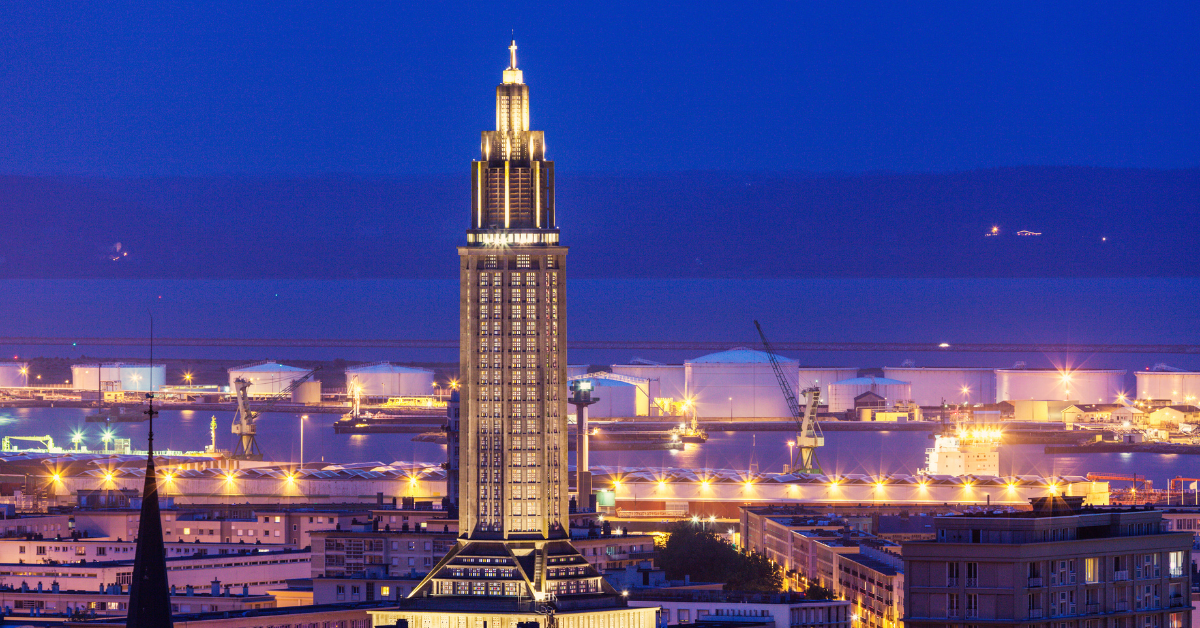


Le Havre is one of France’s largest port cities, yet remains relatively unknown in Japan. This article explores the origin of the Chinese-character version “勒阿弗爾,” examines the impressions Japanese people have of the city, and dives into its port scale, urban design, and sports culture from multiple perspectives.
Basic Facts about Le Havre and Its Importance as a Port
Le Havre is located in the Normandy region and boasts the largest international port on France’s Atlantic coast. It ranks at the top in terms of container and cargo handling within France, serving as a major hub for European maritime transport.
Overview of Le Havre Port
| Item | Content |
|---|---|
| Location | Normandy region, France |
| Port Type | International commercial port |
| Annual Cargo Volume | Over 70 million tons |
| Container Volume | Approximately 3 million TEUs |
| Main Commodities | Oil, chemicals, automobiles, crops |
Additionally, the port houses dedicated car terminals and petrochemical facilities, enabling highly efficient cargo handling operations.
The Origin and Reality Behind the Kanji “勒阿弗爾”
The characters “勒阿弗爾 (Lè’āfú’ěr)” represent a Chinese phonetic translation of Le Havre. Each character is chosen for its phonetic approximation rather than meaning, which is a common method of transliteration in Chinese-character-based cultures.
In Japan, such character-based names are not typically used. The standard is to use Katakana for place names to faithfully reflect the native pronunciation.
Comparison of Foreign Place Name Representations in Japan and China
| City | Japanese Notation | Chinese Notation |
|---|---|---|
| Paris | パリ (Pari) | 巴黎 |
| London | ロンドン (Rondon) | 伦敦 |
| Le Havre | ル・アーヴル | 勒阿弗爾 |
This difference stems from divergent writing traditions. In Japan, character-based renderings are considered largely outdated, and Katakana is preferred for clarity and pronunciation accuracy.
Japanese Impressions of Le Havre and Their Origins
For most Japanese people, Le Havre is not a widely recognized tourist destination. When thinking of French cities, most envision historic buildings and rich cultural heritage, making a modern port city like Le Havre hard to imagine.
Common Images of French Cities Among Japanese People
| City | Commonly Associated Features |
|---|---|
| Paris | Art, museums, Eiffel Tower |
| Nice | Mediterranean resorts, climate |
| Mont-Saint-Michel | History, monasteries |
| Le Havre | Port city, postwar urban design |
As tourism media rarely feature Le Havre prominently, it often goes unnoticed as a travel destination for Japanese tourists.
Le Havre’s Urban Design and Its Unique Characteristics
After severe bombing in WWII, Le Havre underwent a complete rebuild, led by architect Auguste Perret, who applied modernist urban planning using reinforced concrete. The result was a city of geometric harmony, functionality, and unified aesthetics.
Key Elements of Le Havre’s Postwar Rebuilding
| Item | Content |
|---|---|
| Architectural Style | Modernist concrete architecture |
| Lead Architect | Auguste Perret |
| UNESCO Listing Year | 2005 |
| Features | Geometric layout, rational planning, beauty |
Le Havre’s rebuilt cityscape has earned international praise in architecture, and is recognized as a UNESCO World Heritage Site.
Le Havre’s Sports Culture and Local Pride
Surprisingly, Le Havre is also known as a city of sports. Its football club, “Le Havre AC,” is one of France’s oldest and most respected in youth development, having produced many national team players.
Highlights of Le Havre AC
| Item | Content |
|---|---|
| Established | 1872 (One of France’s oldest clubs) |
| Focus | Youth development, community-oriented |
| Notable Alumni | Mendy, Pogba brothers |
| League | Ligue 1, France |
In 2024, the city also served as a venue for the Paris Olympic football tournament, drawing international attention. For residents, attending matches is a weekend tradition deeply rooted in local culture, contributing to the city’s vibrancy.
Future Relations Between Le Havre and Japan
Le Havre is poised for deeper collaboration with Japan, especially in logistics, marine education, and cultural exchange. Joint research between universities is already underway, particularly in marine environmental studies, highlighting the city’s global relevance.
On the business front, Japanese companies are increasingly recognizing the port’s strategic value, while tourists may begin to see Le Havre as an appealing destination not only for history, but also for architecture, urban planning, and sports experiences.
Conclusion
Le Havre is not only France’s largest Atlantic port city, but also a place of multifaceted significance in design, logistics, and sports. In Japan, the city is commonly written as “ル・アーヴル,” while the Chinese-character version “勒阿弗爾” remains unused.
This article presented Le Havre from various angles, showing that its value extends far beyond cargo. As economic and cultural ties grow between France and Japan, Le Havre’s visibility and importance will surely increase, making it a key city for future bilateral understanding.